
If the final five minutes of Lake Mungo left a heavy stone in your stomach, you are not alone. Directed by Joel Anderson, this 2008 Australian mockumentary seems like a slow-burn study of familial grief—right until it rips the rug out from beneath you. The ending reveals a gut-wrenching double truth: Alice Palmer was indeed haunting her family home the entire time, even after her brother admitted to faking early photographic evidence. Her apparition lingered right beside them unnoticed, trapped in silent isolation while her family moved away thinking the haunting was resolved.
Unlike loud supernatural slashers packed with cheap visual tricks, this film weaponizes the negative space of a standard family snapshot. If you want to understand how deep the tragedy goes, we are unpacking the climactic mobile phone footage and pinpointing the five chilling background ghosts you likely overlooked on your first watch.
What You Need to Know
- The Doppelgänger: Alice’s buried cell phone reveals she encountered her own bloated, drowned corpse walking toward her along the dark shores of Lake Mungo days before she died.
- The Double Deception: Mathew faked early video apparitions to force an exhumation, but the end credits reveal real, unedited photos containing Alice’s actual ghost standing right behind them.
- The Core Tragedy: The family moves out believing their home is finally peaceful, inadvertently abandoning Alice’s solitary spirit forever.
- Existential Dread: The horror stems from emotional neglect and foreknowledge of one’s own death rather than demonic forces.
The Lake Mungo Ending Decoded: What Did Alice See?
To decode the climax, you have to rewind to Alice Palmer’s school trip to the arid outback of Lake Mungo. While walking alone near the dried-up lake bed at night, Alice used her flip phone to record her surroundings. Through the grainy darkness, an approaching silhouette emerges: a waterlogged, decaying figure mirroring her face.
Alice witnessed her own drowned doppelgänger—a horrifying premonition confirming her imminent demise. As verified in horror history archives on Wikipedia, this fatalist encounter shattered Alice psychologically, prompting her to hide her phone inside a buried thermos. She spent her final living days carrying the terrifying burden that her life was already over, unable to reach through the emotional distance separating her from her parents.
Much like our breakdown in the Hell House LLC Ending Explained: Basement Ritual Decoded, found-footage relies heavily on environmental storytelling that reframes earlier scenes once secrets emerge.
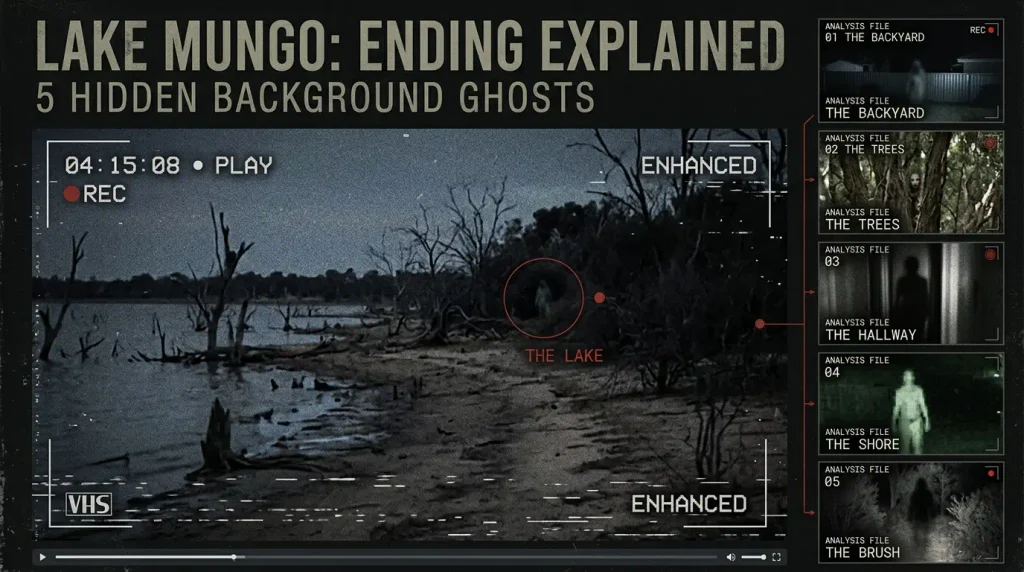
5 Hidden Ghosts You Completely Missed in the Background
During the devastating end credits roll, the film re-examines the Palmer family photographs and video archives. Stripped of Mathew’s amateur Photoshop manipulation, genuine photographic captures surface, proving Alice’s ghost was present during the family’s most intimate moments.
1. The Backyard Window Reflection
Early in the film, the camera pans across the family garden during a sunny afternoon interview. When this footage is stabilized in the post-credits, Alice’s pale, static silhouette is visible staring directly through the rear bedroom window, observing her family grieving her absence while remaining invisible to them.
2. The Empty Living Room Corner
During an interior shot where June Palmer describes her insomnia, an unlit hallway corner in the deep background shows a tall, upright shadow figure. Adjusting the contrast reveals Alice standing motionless against the doorframe, watching her mother weep.
3. The Moving Day Porch Silhouette
As the Palmers load boxes into moving vans to leave the haunted house behind, the camera captures an exterior establishing shot. In the second-story master bedroom window, Alice stands looking down at her family packing up. They drive away believing they have found closure, stranding her ghost in an empty house.
4. The Lake Shoreline Crowd Shot
When search-and-rescue teams comb the lake immediately following the drowning, family photos show friends waiting along the embankment. In the distance, obscured by trees and ambient river mist, an out-of-focus humanoid shape stands watching the recovery of its own body.
5. The Family Portrait Border
In an early family picture displayed on the mantlepiece, the right border of the frame features a blurred distortion near the curtain. The credit sequence crops in to show Alice’s face peeking through the fabric folds, a silent reminder that grief lingered long before her physical death.
- Uses authentic documentary pacing that builds unbearable dread through realism.
- Subverts typical found-footage jump scares in favor of existential grief.
- Forces the audience to actively scrutinize every frame for background details.
- Extremely slow burn that may frustrate fans of frantic monster movies.
- Contains heavy themes of teen isolation, depression, and unaddressed trauma.
Scene-by-Scene Visual Breakdown Table
To grasp the technical mastery of Anderson’s horror construction, review our timestamped breakdown below. You can catch the film streaming on Tubi or on horror platforms like Shudder:
| Title / Scene / Clue | Platform / Timestamp | Deeper Meaning / Vibe | Our Verdict / Impact |
|---|---|---|---|
| The Cell Phone Recovery | Shudder / 1h 18m | Confronting mortality face-to-face | One of horror’s most effective jump-free chills |
| The Moving Van Exit | Tubi / 1h 24m | Total abandonment of the deceased | Emotionally devastating narrative payoff |
| Hallway Still Analysis | End Credits / 1h 26m | The invisible barrier between the living and dead | Forces an immediate second watch |
| Lake Shore Panorama | End Credits / 1h 27m | Witnessing one’s own disappearance | Subtle, masterclass background terror |
If you enjoy discovering eerie oddities hidden on free channels, explore our curated list of 7 Weirdly Terrifying Horror Movies Hidden on Tubi (Free to Watch), or check how modern psychological dread compares in How Scary Is Late Night with the Devil? Jump-Scare Guide.
Hidden Clues & Original Perspective
Critical consensus on Rotten Tomatoes regularly celebrates the film’s realism, but three subtle layers often escape casual discussion:
- The Radio Waves Motif: The ambient radio frequencies and crackling audio design throughout the movie aren’t mere mood music. In early 2000s Australian paranormal folklore, white noise was considered the sole medium through which unresolved dead could reach the living. Alice’s attempts to speak are encoded entirely into the audio mix.
- The Neighbor’s Deceit as a Smokescreen: The sub-plot involving the neighbor’s stolen videotape serves as narrative misdirection. It makes the viewer focus on worldly, true-crime scandals so the true supernatural revelation blindsides you.
- The Inversion of Classic Ghost Stories: Traditional horror films present ghosts as vengeful or malicious entities seeking retribution. Lake Mungo turns this on its head: Alice’s ghost is not dangerous. She is frightened, lonely, and desperate for someone to simply look her way.
For more detailed breakdowns on cinematic tension and unconventional storytelling, consult film histories indexed on IMDb.
Frequently Asked Questions
Did Alice’s brother fake all the ghost photos?
No. While Mathew confessed to editing ghost images onto certain video tapes to convince his parents to exhume Alice’s body, the unedited photographs examined during the end credits show Alice’s actual spirit present in original, unmanipulated frames.
What was the creature Alice saw on her phone?
Alice saw an apparition of her own bloated corpse. It was not a monster or demon, but a premonition of her drowned body that manifested on the shores of Lake Mungo prior to her death.
Why did the family leave the house at the end?
Believing Mathew’s confession proved the haunting was fabricated, the Palmer family concluded that moving on was the healthiest path toward healing. Unknowingly, they left Alice’s spirit trapped alone inside the empty house.
Final Thoughts
Lake Mungo endures because it understands that the scariest thing in the world is not a ghoul jumping from a closet—it is the dread of living unseen and dying forgotten. By hiding Alice in plain sight throughout the credits, the film makes us complicit in overlooking her pain.
Did you spot Alice standing in the window during your first viewing, or did you only notice during the end credits? Drop your theories in the comments below!